SEO blog writing is not a trend. It is the most reliable way for a small business to earn organic visibility that compounds over time. But most businesses approach it backward: they write first, then try to apply SEO. That is like building a house and adding the foundation last.
This guide covers every element that separates blog content that ranks from blog content that sits unread. Whether you are writing your own posts or evaluating a professional SEO blog writing service, understanding these strategies lets you make better decisions at every step.
What you will learn in this guide
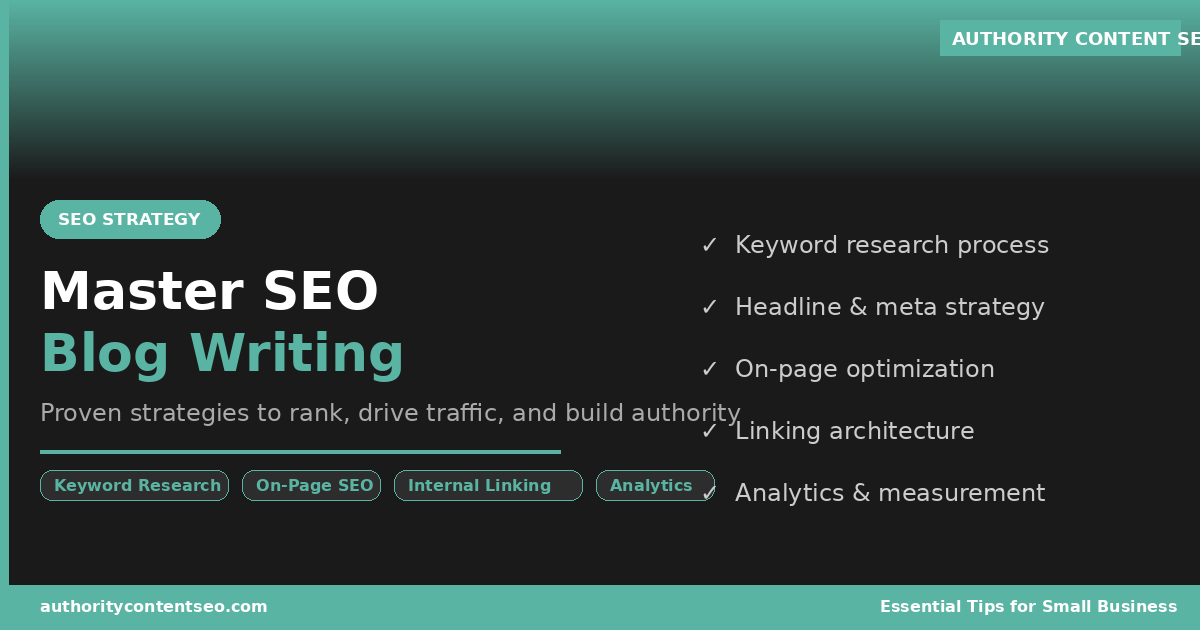
Keyword research fundamentals → headline and meta description strategy → post structure for rankings → on-page optimization → internal and external linking → mobile and page speed → promotion tactics → analytics and measurement → voice search, local SEO, and evergreen content.
What Is SEO Blog Writing and Why Does It Matter?
SEO blog writing is the practice of crafting blog content that ranks well in search engines while genuinely serving the reader. It is not about stuffing a post with keywords. It is about understanding what a specific searcher needs, delivering that completely, and signaling to search engines that your content is the right answer.
Without an SEO strategy behind your blog, even well-written posts rarely surface in organic search. That means your content reaches only the audience already following you, rather than the much larger audience actively searching for what you offer. Organic traffic does not stop when you stop spending. A well-optimized post can drive qualified visitors for months or years after it is published.
Three outcomes follow from consistent, well-executed SEO blog writing:
- Increased reach — Posts appear in front of searchers who have never heard of your business.
- Higher engagement — Content structured around search intent keeps readers on the page longer.
- Better conversion — Visitors arriving from organic search are often actively looking for a solution, making them higher-intent prospects than cold traffic.
Keyword Research: The Foundation of Every Post
Keyword research is the step most small businesses skip or rush, and it is the primary reason their blog content does not rank. Before writing a single sentence, you need to know the exact phrase your target reader types into Google and how competitive that phrase is.
Use tools like Google Keyword Planner or Semrush to analyze search volume and competition for any keyword you are considering. A keyword with 50,000 monthly searches sounds attractive until you find that every result on page one is a major publication with thousands of backlinks. A phrase with 400 monthly searches, low competition, and clear commercial intent can outperform it significantly in terms of actual business results.
A practical keyword research process
Step 1 — Start with topics. List five to ten broad themes your business speaks to. For a bookkeeping firm, that might be "small business accounting," "tax preparation," and "cash flow management."
Step 2 — Find specific queries. Enter each topic into a keyword tool and look for long-tail variations with lower competition and clear reader intent.
Step 3 — Check the intent. Search the phrase yourself. If results are all e-commerce product pages, a blog post will not rank there. If they are guides and how-to articles, you have a clear content opportunity.
Step 4 — Map to pages. Assign one primary keyword per post. Never try to rank one post for five different keywords.
For businesses that want keyword research handled systematically as part of a monthly plan, the Authority Starter Package includes this work with every content cycle.
Crafting Headlines and Meta Descriptions That Get Clicked
A post that ranks on page one but never gets clicked delivers no value. Your headline and meta description are the two elements that determine whether a searcher clicks your result or moves to the next one.
Headlines
A strong headline accomplishes three things: it includes the primary keyword naturally, it signals the value the reader will receive, and it creates enough interest to earn the click. Numbers and specificity help. "5 ways to improve cash flow" outperforms "tips for better cash flow" because the reader knows exactly what they are getting before they arrive.
Avoid headlines that are clever at the expense of clarity. A reader scanning search results has no patience for ambiguity. The headline that ranks and converts answers "why should I read this?" in under ten words.
Meta Descriptions
Meta descriptions do not directly influence rankings, but they influence click-through rate, which influences rankings indirectly over time. Write meta descriptions as a one-to-two sentence preview that surfaces the specific benefit of reading your post. Include the primary keyword naturally, stay under 155 characters, and end with a clear action prompt.
A common meta description mistake
Leaving meta descriptions blank or duplicating them across posts. When you leave them blank, Google generates them automatically from page content, often pulling sentences that do not represent the post well. Every post deserves a hand-written meta description.
Structuring a Blog Post for Rankings and Readability
Search engines and human readers share one preference: clear, logical structure. A well-organized post is faster to scan, easier to read, and sends stronger topical signals to Google. Structure is not formatting for its own sake. It is how you demonstrate that you have fully covered a topic.
- H1 (title): One per post. Contains your primary keyword. Sets the main topic.
- H2 (main sections): Divide the post into its core ideas. Each H2 should address a distinct subtopic. Include keyword variations naturally where they fit.
- H3 (subsections): Break down complex H2 sections when a section genuinely splits into multiple distinct ideas. Do not use H3 for decoration.
- Introduction: State the problem, confirm the reader is in the right place, and preview what they will learn. Introduce your primary keyword within the first 100 words.
- Conclusion or CTA: Summarize the key takeaway and give the reader a clear next step, whether that is reading another post, contacting you, or exploring your services.
Bullet points and numbered lists are useful for presenting parallel information, steps in a process, or sets of examples. Avoid turning an entire post into a list. Prose paragraphs carry explanatory weight that bullet points cannot replace.
Writing High-Quality, Engaging Content
Every SEO strategy collapses without content that is actually worth reading. Rankings bring readers to your post. What keeps them there, and what converts them, is quality.
Quality in SEO blog writing means several specific things:
- Specificity over generality. "Keep good records" is not useful advice. "Retain bank statements, invoices, and receipts for at least seven years" is. The more concrete your content, the more time readers spend with it.
- Original perspective. The internet already has thousands of posts on any topic. What makes yours worth reading is a perspective or insight that others are not providing.
- Plain language. Write at the level your reader actually uses. Industry jargon alienates the very audience you are trying to convert into customers.
- Appropriate length. Cover the topic fully without padding. A 600-word post that fully answers a focused question outperforms a 2,500-word post that repeats the same idea in different words.
Multimedia elements such as relevant images and diagrams extend time on page and add clarity that text alone cannot always deliver. Every image should include descriptive alt text for both accessibility and search indexing.
On-Page Optimization: Headers, Images, and Links
On-page SEO is the set of signals you control directly within the post itself. Getting these right does not guarantee rankings, but getting them wrong actively works against you.
| On-Page Element | Best Practice | Common Mistake |
|---|---|---|
| Title tag (H1) | Include primary keyword near the front | Clever but keyword-free headline |
| Meta description | Unique description under 155 characters for every post | Duplicate or blank meta descriptions |
| URL slug | Short, keyword-based, hyphen-separated | Auto-generated numeric or date-based URLs |
| Image alt text | Describe the image accurately; include keyword when natural | Alt text left blank or stuffed with keyword strings |
| Image file size | Compress before uploading; use WebP where supported | Uploading raw high-resolution photos |
| Internal links | Link to relevant pages with descriptive anchor text | No internal links, or generic "click here" anchors |
| External links | Link to authoritative sources where they add genuine value | Avoiding all outbound links out of misplaced caution |
Internal and External Linking Strategy
Internal links are one of the most underused SEO levers available to small business blogs. Every time you link from one post to another, you pass authority between pages and guide readers deeper into your site. Over time, a well-linked blog creates a topical cluster that signals to search engines that you have comprehensive authority on a subject.
When you publish a new post, identify two or three existing posts or pages it relates to and link to them. When you publish future posts, go back and add links from older content to the new post. This ongoing internal linking practice builds a content architecture rather than a collection of disconnected articles.
External links, pointing outward to authoritative sources, signal that your content is part of a well-researched, credible conversation. The idea that external links "leak authority" is outdated. Appropriate outbound links improve the reader experience and are a signal of quality, not a liability.
For a deeper look at how internal link architecture supports rankings across a full site, see our overview of professional SEO blog writing services and how each post is positioned within a broader content strategy.
Mobile Optimization and Page Speed
More than half of all web traffic now comes from mobile devices. A blog post that renders correctly on desktop but breaks on a phone loses a majority of its potential readers before they read a word. Responsive design is mandatory for any site competing in organic search today.
Page speed is equally important. Google uses Core Web Vitals as ranking signals, and slow pages lose both rankings and readers. The most common causes of slow blog pages are oversized images, render-blocking scripts in the document head, and uncompressed CSS and JavaScript. Most of this can be addressed through image compression before upload and basic caching settings in your hosting environment without developer involvement.
Quick wins for blog page speed
Compress all images before uploading using tools like Squoosh or TinyPNG. Load Google Fonts asynchronously or self-host them. Enable caching through your hosting panel or CMS settings. Minimize third-party scripts that are not directly contributing to the page experience.
Promoting Your Blog Content for Maximum Reach
Publishing a post does not create traffic. Distribution does. A well-optimized post earns organic traffic as it gains rankings over time, but in the short term, promotion gets it in front of an initial audience and generates the early engagement signals that help it rank faster.
The most effective promotion channels for small business blog content are:
- Email newsletter: Your existing list is your most reliable initial audience. Share each new post with a brief summary and a direct link. Readers who click and spend time on the page send positive engagement signals back to search engines.
- Social media: Share posts where your audience is actually active. For most B2B small businesses, that means LinkedIn. For consumer-facing businesses, Instagram or Facebook may be more relevant. Concentration beats spreading across every platform.
- Content repurposing: A 2,000-word blog post contains multiple standalone ideas. Pull one insight for a LinkedIn post. Convert a numbered list into an infographic. Record a two-minute video summarizing the main concept. Each format reaches a different segment of your audience.
- Strategic outreach: If your post references research, quotes an expert, or covers a topic relevant to another site's audience, let them know. A brief, specific message noting the connection often earns a mention or a backlink.
Measuring Performance: Analytics and SEO Tools
You cannot improve what you do not measure. Every SEO blog strategy needs a measurement layer to identify what is working, what is underperforming, and where the next opportunity lies.
Google Analytics and Google Search Console are the two essential free tools. Analytics shows traffic volume, time on page, bounce rate, and conversion behavior. Search Console shows which queries are triggering your pages, your average ranking position, and your click-through rate. Together, they provide a complete picture of post performance.
Key metrics to track for each post:
- Organic impressions and clicks (Search Console) — Is the post appearing in results? Is it earning clicks?
- Average position (Search Console) — Positions 1 to 3 capture the majority of clicks. Posts ranking 11 to 20 are close to the first page and often respond well to targeted content updates.
- Time on page (Analytics) — Short average times on a long post usually indicate the content is not matching what the reader expected to find.
- Bounce rate (Analytics) — High bounce rates on well-ranked posts suggest a mismatch between the search intent and the content delivered.
- Conversions (Analytics) — Track whether blog readers take the actions that matter: contacting you, visiting a service page, or downloading a resource.
For a step-by-step framework for tracking content performance, the Content Marketing Analytics 101 guide walks through setup from scratch.
Advanced Tactics: Voice Search, Local SEO, and Evergreen Content
Voice Search Optimization
Voice search queries are longer and more conversational than typed searches. Someone typing might search "best accounting software small business." The same person speaking into a phone says "what is the best accounting software for a small business?" Writing content that answers naturally phrased questions, and including those question phrases in your headings, positions posts well for voice results. FAQ sections are particularly effective for capturing this format.
Local SEO for Blog Content
For businesses serving a specific geographic market, local search intent is an opportunity most blog strategies ignore. A Dallas accounting firm publishing "When Should a Dallas Small Business Hire a Bookkeeper?" is competing for a narrower, more commercially relevant keyword than one targeting the same topic nationally. Geo-specific posts serve local intent, build local authority, and attract the readers most likely to become customers. For Texas-based businesses, our Texas SEO blog writing services are built around exactly this approach.
Evergreen Content
Evergreen content addresses topics that remain relevant regardless of when they are read. "How to write a business plan" will be searched next year and the year after. A healthy blog mix includes both timely posts that build topical relevance when published and evergreen posts that generate steady traffic indefinitely. Evergreen posts deserve more investment in depth, structure, and periodic updates. They are the long-term assets of your content portfolio.
When to Consider an SEO Blog Writing Service
SEO blog writing done well requires consistent time across keyword research, writing, editing, on-page optimization, internal linking, and performance tracking. For most small business owners, that represents several hours per post, every month, indefinitely. The question is not whether the strategy works. It does. The question is whether executing it yourself is the best use of your time.
A professional SEO blog writing service handles the entire workflow: keyword identification, content planning, writing, optimization, and delivery. You approve the content and focus on your business. The blog compounds in the background.
The businesses that see the strongest return from outsourced SEO blog writing are those that commit to a consistent monthly cadence rather than one-off posts. Topical authority builds through volume and consistency over time, not through a single excellent article.
What to look for in an SEO blog writing service
A service should be able to explain its keyword research process, demonstrate how posts are structured for search intent, show examples of posts that are currently ranking, and provide transparent reporting on performance. If a service cannot articulate what separates a post written to rank from a post written to exist, find a different one.
Frequently Asked Questions About SEO Blog Writing
What is SEO blog writing?
SEO blog writing is the practice of creating blog content structured around specific keywords and search intent so that it ranks in search engine results. It combines keyword research, on-page optimization, clear structure, and compelling writing to attract organic traffic rather than relying on paid advertising.
How do I start keyword research for blog posts?
Start by identifying broad topics relevant to your business, then use tools like Google Keyword Planner or Semrush to find specific keyword phrases your audience searches. Look for a mix of primary keywords with decent search volume and secondary or long-tail keywords with lower competition. Map one primary keyword to each post before writing begins.
How long should an SEO blog post be?
There is no universal length requirement. A post should be as long as it needs to fully answer the searcher's question. Informational guides typically perform well at 1,500 to 2,500 words, while highly competitive topics may require more depth. Focus on completeness and clarity rather than hitting a specific word count.
What is the difference between SEO blog writing and regular blog writing?
Regular blog writing focuses primarily on the reader experience. SEO blog writing does this too, but also incorporates deliberate keyword placement, structured headings, internal linking, meta descriptions, and content formatted to satisfy search engine ranking signals. Both must read naturally; SEO blog writing adds a strategic layer on top of quality writing.
When should I hire an SEO blog writing service?
Consider hiring an SEO blog writing service when you lack the time or specialized expertise to research, write, and optimize posts consistently. A professional service handles keyword strategy, writing, on-page SEO, and internal linking so your blog produces compounding organic traffic without pulling you away from running your business.